

B2B Email Marketing: How to use email to drive B2B pipeline growth

If you‘ve ever wondered why B2B email marketing still dominates as a revenue-driving channel in 2025, you’re not alone. Despite the rise of new marketing platforms and AI-powered tools, B2B email marketing remains one of the most reliable ways to nurture leads, accelerate pipeline, and actually close deals.
When done right, email provides the space to build trust, educate decision-makers, and stay top of mind throughout the entire journey.
In this guide, I’m walking you through how to build a B2B email marketing strategy that actually drives revenue, from segmentation and automation to the metrics that matter to your leadership team.
![→ Download Now: The Beginner's Guide to Email Marketing [Free Ebook]](https://no-cache.hubspot.com/cta/default/53/53e8428a-29a5-4225-a6ea-bca8ef991c19.png)
Table of Contents
- What is B2B Email Marketing?
- Why B2B Email Marketing Drives Pipeline
- How to Build a B2B Email Marketing Strategy
- The Mindset Shift That Makes This Work
- B2B Email Segmentation and Personalization
- B2B Email Automation Workflows to Set Up First
- B2B Email Marketing Best Practices Checklist
- B2b Email Templates and Examples That Work
- B2B Email Marketing Software and Tools to Use
- Frequently Asked Questions About B2B Email Marketing
What is B2B Email Marketing?
B2B email marketing refers to businesses sending emails to other companies, as opposed to individual consumers (B2C). For example, instead of trying to convince someone to buy a new pair of sneakers for themselves, you‘re reaching out to a company’s purchasing manager to discuss enterprise software, bulk office supplies, or professional services.
Although the acronyms may be similar, B2B email marketing differs significantly from B2C email marketing.
B2C emails can be spontaneous and emotion-driven (hello, flash sales and FOMO!), but B2B emails require a more strategic and informative approach. You‘re not just talking to one person who’s shopping on their lunch break; you’re often addressing multiple stakeholders who need to justify every purchase to their team.
The CFO wants to see ROI projections, the IT director needs to know about integration capabilities, and the end users want to understand how it‘ll make their jobs easier. That’s why B2B buying cycles are so much longer — we’re talking weeks or even months instead of “add to cart right now.”
I‘ve found that B2B email marketing really shines because it gives you the space to nurture these complex relationships over time. You can send a whitepaper to the marketing director one week, follow up with a case study for the VP, and then circle back with implementation details when they’re finally ready to make a decision.
It’s all about building trust and providing value at every stage of that lengthy journey, which is precisely why email remains such a powerful channel for B2B marketers.
Why B2B Email Marketing Drives Pipeline
It’s crucial that marketers understand that email marketing b2b lead generation is more than just a broadcast tool whose worth can be measured solely in opens and clicks. By recognizing B2B email marketing as a revenue channel, you can measure pipeline contribution and deal velocity.
That said, here’s how email actually drives pipeline:
- Targeted personalized content – With B2B email marketing, you can segment your audiences by industry, role, or behavior. Thus, allowing for hyper-relevant messaging that significantly boosts open, click-through, and response rates compared to non-targeted email blasts.
- Lead nurturing and education – Use your B2B emails to deliver valuable content, such as webinars, case studies, industry insights, tailored to buyer behavior, educating prospects, and keeping your brand top-of-mind during long B2B sales cycles.
- Behavioral Intent Signals for Sales – When a contact from a target account suddenly opens three emails in one day, visits your pricing page, and downloads a case study, that‘s not just engagement—it’s a buying signal. Modern email platforms surface these signals to sales in real-time, effectively turning marketing email into a lead enrichment and qualification engine.
The B2B Email Marketing Revenue Measurement Framework
Treating email as a revenue channel means measuring it like one:
- Pipeline sourced: How many opportunities were created where email was the first or last point of contact?
- Pipeline influenced: How many deals in your CRM showed meaningful email engagement before closing?
- Velocity impact: Do deals with high email engagement close faster than those without?
- Average contract value: Are email-nurtured deals larger because buyers are better educated?
How to Build a B2B Email Marketing Strategy
Step 1: Audit Your Current State (Week 1)
Before building an effective B2B email marketing strategy, you‘ll need to understand what you’re working with, so look into the following metrics from the last 6 months:
- Total database size and growth rate
- Deliverability metrics (bounce rate, spam complaints)
- Engagement by segment (industry, company size, lifecycle stage)
- Unsubscribe patterns (when and why people opt out)
- Current pipeline contribution from email (if tracked)
Then, interview your sales team:
- What objections do they hear repeatedly?
- At what point do deals typically stall?
- Which content pieces actually help close deals?
- What questions do prospects ask before they’re ready to talk?
Tracking the above metrics and consulting your sales team will help you identify any gaps in your current strategy. Perhaps your database is growing, but engagement is declining, suggesting a targeting issue. Maybe sales loves your content but doesn’t know when prospects engage with it, presenting an issue with integration.
Step 2: Define Your Revenue Goals and Work Backwards (Week 1)
I know this sounds strange, but once you‘ve set your revenue goals, you’re going to want to start from the end. Yep, that‘s right. The end. Here’s what I mean:
Work backwards from your annual target:
If you need to generate $5M in pipeline this year, and your average deal size is $50K, you would need 100 opportunities influenced by email
At a 20% email-to-opportunity conversion rate, you need 500 marketing-qualified engagements, which means X number of targeted sends to Y segments.
This math becomes your North Star. Every program you build should align with these numbers. This approach transforms email marketing B2B lead generation from a volume game into a predictable revenue engine.
Step 3: Map Your Buyer’s Journey (Week 2)
This is where most strategies tend to become theoretical. Keep it practical, and create a simple three-stage framework:
Early Stage (Problem Aware): A prospect may know they have a problem, but isn’t actively evaluating solutions yet. Your email goal should be to educate and provide perspective, not to pitch. For example, your B2B email can include industry trend reports, challenge-focused content, and peer insights.
Mid-Stage (Solution-Aware): Your target audience is researching options and building requirements. Let your email goal be to position your approach and build preference.
For example, you can provide framework content, methodology explainers, and comparison guides that don’t bash competitors but show your differentiation.
Late Stage (Vendor Evaluation): They’re in active conversations with you or competitors. Email goal: Reinforce value, address objections, create urgency. Example: Customer proof, ROI calculators, implementation timelines, executive insights.
For each stage, write down the 3-5 questions prospects actually ask. Your content should answer those questions before sales even gets on the phone.
Step 4: Segment Your Database for Relevance (Week 2-3)
Generic email is dead. But over-segmentation is paralyzing. Find the middle ground.
Start with these four dimensions:
Engagement level: Active (opened/clicked in last 30 days), warming (30-90 days), cold (90+ days), unengaged (never). Different groups need completely different approaches.
Account fit: ICP accounts vs. non-ICP. If someone‘s at a 50-person company and you only sell to enterprise, don’t waste their time or yours with enterprise-focused content.
Lifecycle stage: Subscriber, MQL, SQL, opportunity, customer. A prospect in an active deal needs reinforcement content, not top-of-funnel education.
Behavioral signals: Product page visits, pricing page views, competitor comparison downloads, and case study consumption. These indicate buying intent and should trigger different workflows.
The goal isn‘t to create 47 segments. It’s to ensure the right person gets the right message at approximately the right time.
Step 5: Build Your Core Program Architecture (Week 3-4)
Think of your email program as a system of interconnected campaigns, not one-off sends.
The five programs every B2B email strategy needs:
Welcome/Onboarding Series: Someone just subscribed or downloaded content. You have their attention for maybe 72 hours. Use it. 3-5 emails over 2 weeks that establish credibility, set expectations, and move them toward a next action.
Nurture Tracks by Persona/Stage: Long-running sequences (8-12 emails over 3-6 months) that educate and build preference. Don’t make these feel like a drip campaign—space them thoughtfully and make each email valuable standalone.
Re-engagement Campaigns: Your database decays 25% annually. Proactive re-engagement for people going cold prevents list atrophy. “We’ve noticed you haven’t engaged—what would be more valuable to you?” Then act on their feedback or gracefully let them go.
Pipeline Acceleration: Triggered sends based on deal stage or account activity. When an opp hits “Technical Review” stage, relevant stakeholders automatically get implementation case studies. This is where email directly impacts close rates.
Customer Expansion: Your easiest revenue is sitting in your install base. Regular customer-only newsletters, feature updates, advanced use case content, and expansion plays. Track this to upsell/cross-sell revenue.
Step 6: Create Your Content Engine (Week 4-6)
You can‘t execute an email strategy without content, but you don’t need to create everything from scratch.
Audit what you already have:
- Sales decks and one-pagers can become email content
- Webinar recordings can be chunked into insight emails
- Customer calls contain objection-handling gold
- Product marketing has competitive intelligence sitting unused
Build a content matrix: Map your existing assets to buyer stages and personas. Identify the 5-7 critical gaps where you have nothing valuable to send. Prioritize creating those pieces.
Establish a sustainable cadence: Most B2B companies can‘t sustain weekly content creation. That’s fine. Plan for what you can actually execute—maybe one strong piece per month, repurposed across channels, with email as the primary distribution vehicle.
Step 7: Set Up Your Tech Stack and Tracking (Week 5-7)
Strategy means nothing if you can’t execute and measure it.
Essential infrastructure:
Email platform connected to CRM: Bidirectional sync so behavior flows to sales records and CRM data informs email targeting. If these systems don‘t talk, you’re just guessing.
UTM parameters on every link: Consistent naming convention so you can track email’s contribution in your analytics platform. Format: utm_source=email&utm_medium=nurture&utm_campaign=q4_product_series&utm_content=email_3
Lead scoring integration: Email engagement should influence lead scores. Someone who opens 5 emails in a week and clicks through to pricing is more sales-ready than someone who filled out a form once and disappeared.
Dashboard for key metrics: Opens and clicks matter, but only as leading indicators. Your dashboard should show: email-sourced pipeline, email-influenced pipeline, MQL generation, conversion rates by campaign, and unsubscribe/deliverability trends.
Step 8: Launch, Learn, and Iterate (Ongoing)
Start with your highest-impact program first. Don’t try to launch everything simultaneously.
Month 1-2: Pilot Your Top Priority If pipeline generation is urgent, start with a mid-funnel nurture targeting engaged contacts at ICP accounts. If database growth is the issue, nail your welcome series first.
Test systematically, not randomly:
- Subject lines and send times are table stakes tests
- More valuable: Test content approaches (education vs. social proof), CTAs (demo vs. content download), and segmentation hypotheses (do enterprise contacts respond better to executive content?)
Monthly review cadence: Look at both program-level performance (is the nurture track generating MQLs?) and tactical execution (are emails rendering correctly?). Adjust based on data, not opinions.
Quarterly strategy refresh: Are the buyer journey stages still accurate? Has competitive positioning shifted? Are there new objections sales is hearing? Your strategy should evolve with your market.
Step 9: Integrate Email With the Broader GTM Motion (Month 3+)
Email works best when it’s not isolated.
Sales enablement loop: Share engagement reports with sales weekly. “Here are the 15 accounts showing buying signals based on email behavior.” Make it easy for them to act on email intelligence.
Content syndication: Every piece of pillar content gets an email campaign, a LinkedIn series, a webinar, and sales enablement. Email is the distribution engine, not the entire strategy.
Account-based integration: For your top 50 target accounts, coordinate email with ad retargeting, direct mail, and SDR outreach. Multi-channel orchestration dramatically improves conversion.
Following B2B email marketing best practices means treating email as part of your integrated go-to-market strategy, not an isolated channel.
The Mindset Shift That Makes This Work
After ten years, here’s what I know: The companies that win with email marketing treat it as a strategic function, not a tactical one. They staff it appropriately, give it a real budget, and measure it against revenue metrics.
They also accept that building a mature email program takes 6-12 months. You’ll see early wins—better engagement, some pipeline contribution—but the compounding effects of good nurture, consistent sending, and improving segmentation take time to materialize.
Start with the foundation, launch progressively, and optimize relentlessly. The tactics will evolve, but this strategic approach won’t.
B2B Email Segmentation and Personalization
Demographic
Demographic segmentation means dividing your email list based on demographic information, such as age, gender, job title, education level, and more. In the case of B2B email marketing, specifically, you’ll want to focus on demographic characteristics like role, job title, and level of authority.
Behavior
For behavioral segmentation, you will separate your email list based on audience behaviors and actions, which include their browsing habits, email engagement, and purchase history. Doing so allows you to send content tailored to the links your recipients clicked or the purchase they’ve made.
Firmographic
Firmographic segmentation is highly specific to B2B email marketing and involves segmenting your audience based on characteristics of the companies they work for. Characteristics to consider include industry, company size, annual revenue, and location.
Intent
Intent segmentation involves dividing your email list based on the interests, opinions, and attitudes of your audience. In intent segmentation, you’ll likely consider values, beliefs, personality traits, and lifestyle.
In terms of B2B, this segmentation would involve dividing your audience based on their business goals and values, such as companies prioritizing sustainability over growth.
B2B Email Automation Workflows to Set Up First
Not sure where to start with B2B email automation workflows? No worries, I’ve got you covered. Here are four workflows you should set up first.
Welcome and Onboarding
B2B welcome and onboarding email automation kicks off when a new lead signs up or a customer completes a purchase, sending a series of emails that introduce your company, set expectations, and guide them through initial setup.
It’s your first impression at scale, helping new contacts understand your value proposition while reducing the learning curve for your product or service. A smooth onboarding experience is crucial because it directly impacts activation rates and long-term retention—people who receive value quickly tend to stick around.
To set it up, map out the key actions you want new users to take in their first 30 days, then create a sequence of 3-7 emails spaced over that period, each focused on one specific goal or feature.
Lead Nurture by Pain and Persona
This workflow segments leads based on their specific challenges or roles, then delivers targeted content that speaks directly to their situation, such as sending CFOs ROI calculators while sending IT managers technical specifications.
It’s essential because generic messaging often falls flat in B2B, where different stakeholders prioritize entirely different things. By addressing the actual problems your prospects are facing, you build trust and move them toward a purchase decision much faster than spray-and-pray approaches.
Set it up by creating buyer personas with their unique pain points, tagging leads accordingly (through forms, behavior, or enrichment data), and building content tracks that progressively address each segment’s concerns.
Product Education and Expansion
The product education and expansion email workflow educates existing customers about features they haven‘t yet adopted or introduces complementary products they may need. It’s typically triggered by usage patterns or account milestones.
This workflow is important because most B2B products have low feature adoption rates, meaning customers aren’t getting full value, and unhappy customers churn.
By proactively teaching customers about capabilities that solve their evolving needs, you increase product stickiness and create natural upsell opportunities.
To implement it, identify underutilized features or logical upgrade paths, set behavioral triggers (like “hasn’t used X feature after 60 days”), and create educational sequences that combine how-to content with compelling use cases.
Re‑engagement and Win‑back
This workflow targets inactive leads or churned customers with compelling reasons to reconsider, often including special offers, new features, or case studies showcasing results.
Re-engagement/win-back segmentation matters because acquiring new customers costs 5-25x more than re-engaging existing ones, and circumstances change. The timing that was wrong six months ago might be perfect now.
These campaigns can resurrect relationships that represent significant untapped revenue with relatively low effort.
Set it up by defining what “inactive” means for your business (no logins for 90 days, no email opens for 6 months), segment by why they likely disengaged, and craft 2-4 touchpoints that acknowledge the lapse, highlight what’s new or different, and include a clear, low-friction path back.
B2B Email Marketing Best Practices Checklist
Here are some best practices to check off when crafting and sending B2B marketing emails. To automate the process, you can use tools like Breeze AI Email Writer.
☐ Segment ruthlessly for relevance – Send targeted messages based on industry, company size, role, and behavior to increase open rates by 14% and click rates by 100%+
☐ Write subject lines that promise value, not clickbait – Keep them under 50 characters, lead with benefits or curiosity, and A/B test to find what drives your audience to open
☐ Personalize beyond the first name – Reference company details, past interactions, or specific pain points to build genuine connections that move deals forward
☐ Make your CTA impossible to miss – Use one primary call-to-action per email, make it visually prominent, and use action-oriented copy that tells recipients exactly what happens next
☐ Optimize for mobile (60% of B2B emails are opened there) – Use responsive design, keep paragraphs short, ensure buttons are thumb-friendly, and front-load your key message
☐ Test send times strategically – For B2B, Tuesday-Thursday between 10am-2pm typically performs best, but test your specific audience’s patterns to maximize engagement
☐ Clean your list religiously – Remove inactive subscribers quarterly to maintain deliverability, protect sender reputation, and keep your metrics accurate
☐ Track metrics that matter to revenue – Monitor beyond opens and clicks to conversion rates, pipeline influence, and ultimately closed revenue attributed to email campaigns
B2b Email Templates and Examples That Work
B2B Marketing Emails at the Awareness Stage
B2B marketing emails in the awareness stage of the marketing funnel usually come in the form of:
- Education content: Links to blog posts, reports, or knowledge pertaining to niche issues and trends common in the recipient’s industry
- Resources: Helpful tools or guides that allow recipients to diagnose issues within their business and find solutions
- Newsletters: Emails containing the latest industry news, expert insights, and trends.
- Event Invites: Links to free webinars, online workshops, and digital conferences
Below is an example of a newsletter from The Hustle. The Hustle’s newsletter offers funny, irreverent, yet helpful and up-to-date insights into the latest industry news and niche trends.
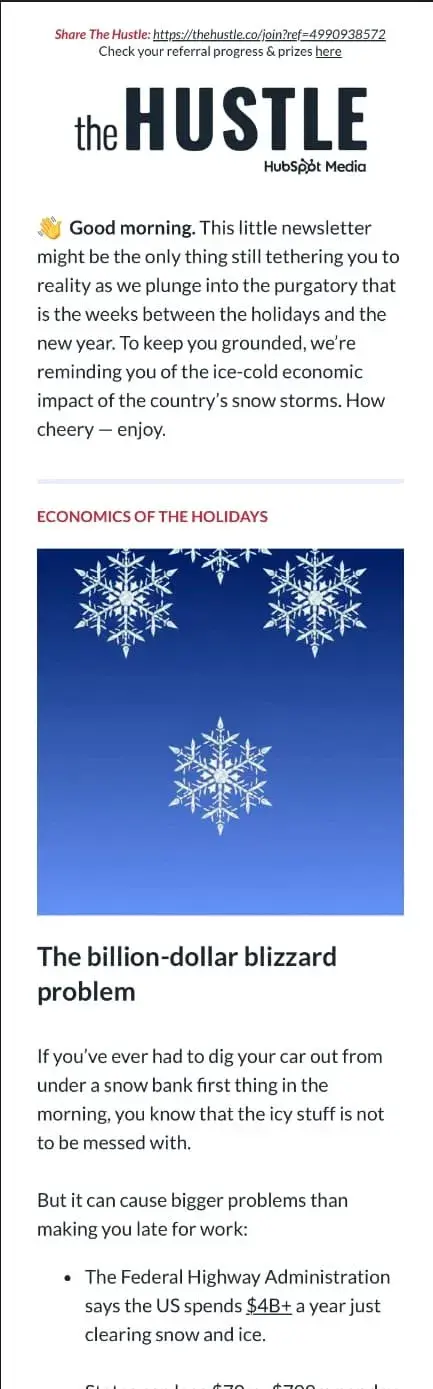
At the awareness stage, prospects are aware they have a problem or an area of improvement they want to address. At the very least, they want more knowledge about their industry. That’s where B2B emails like the ones above come in handy.
B2B marketing at the awareness stage works by providing your audience with helpful information and resources, establishing your brand as a trusted industry expert. If you can be trusted to know your industry, then you can be trusted to offer great products and services.
B2B Marketing Emails at the Consideration Stage
B2B email marketing at the consideration stage consists of the following email types:
- Case Study Emails: Show proven track record of success by including specific examples of your products/services improving other businesses.
- Comparison Guide / Whitepaper Offer: Compares other solutions from competitors in your niche to help your audience decide for themselves if they’d like to work with you.
- Product Demo Invite: Enables the recipient to visualize the solution in action by demonstrating its functionality.
At the consideration stage of the funnel, your B2B marketing emails should focus on demonstrating the value of your company‘s products and services. Now, you’re moving from sending out general information to solutions-based content with calls-to-action, such as “Click This Demo” or “Download Guide.”
B2B Marketing Emails at the Decision Stage
B2B marketing emails at the decision stage focus on closing. At this point, your audience has been aware of the problem, already sought a solution, and is now ready to buy, sign up, or commit. Now you need to get them to the finish line.
At the decision stage, B2B email marketing materials are typically:
- Personalized Demos and Content Offers: These emails provide direct value tailored to the recipient’s specific needs.
- Customer Testimonials and Success Stories: Similar to case studies, these materials share testimonials and real-life situations in which your products and services have been successful.
- Free Trial / Pilot Offer: A low-risk opportunity to allow the recipient to try your products/services.
- Implementation / Onboarding Focus: Provides resources on how to integrate or transition to your service seamlessly.
B2B Email Marketing Software and Tools to Use
Finding the right B2B email marketing tool or software can be a chore, so I made it easier on you by listing my top four.
- Pricing: Free plan available; Marketing Hub starts at $20/month (Starter), $890/month (Professional), $3,600/month (Enterprise)
- Standout features: All-in-one CRM integration, advanced automation workflows, A/B testing, detailed analytics, lead scoring, and seamless integration with sales tools
- Free trial: Free plan available with basic features; paid plans offer 14-day free trial
- Pricing: Free plan for up to 500 contacts; paid plans start at $13/month (Essentials), $20/month (Standard), $350/month (Premium)
- Standout features: User-friendly interface, extensive template library, predictive segmentation, multivariate testing, and strong e-commerce integrations
- Free trial: Free plan available; paid plans offer a 14-day free trial
- Pricing: Starts at $15/month (Starter), $49/month (Plus), $79/month (Pro), $149 for Enterprise
- Standout features: Sophisticated automation capabilities, CRM functionality, lead scoring, SMS marketing, and conditional content
- Free trial: 14-day free trial available
- Pricing: Starts at $12/month (Lite), $35/month (Standard), $80/month (Premium)
- Standout features: Easy-to-use drag-and-drop editor, event marketing tools, social media integration, and excellent customer support
- Free trial: 14-day free trial available
- Pricing: Free plan available; paid plans start at $9/month (Starter), $18/month (Standard), $499/month (Professional), and custom pricing for Enterprise
- Standout features: SMS marketing included, transactional email capabilities, marketing automation, chat functionality, and pay-as-you-go email options
- Free trial: Free plan available with up to 300 emails/day
Frequently Asked Questions About B2B Email Marketing
How do I start B2B email marketing from scratch?
Begin by selecting an email marketing platform that aligns with your budget and technical requirements, such as HubSpot or Mailchimp. Build your initial email list through website opt-in forms, content downloads, and networking events, while ensuring compliance with regulations such as GDPR and CAN-SPAM.
Create a content strategy that addresses your target audience’s pain points and business challenges, then segment your list based on industry, company size, or buyer journey stage.
Set up automated welcome sequences and nurture campaigns to engage new subscribers, and establish key performance metrics to track your success from day one.
How often should you send B2B emails?
The ideal B2B email frequency depends on your audience, content value, and industry, but most successful B2B companies send between 2-4 emails per month to avoid overwhelming subscribers while maintaining engagement.
Weekly emails work well for newsletters or thought leadership content, while promotional or sales-focused emails should be sent more sparingly to prevent list fatigue.
Test different frequencies with your specific audience and monitor unsubscribe rates and engagement metrics to determine the optimal frequency for your audience.
Always prioritize quality over quantity—it’s better to send one highly relevant, valuable email than multiple mediocre ones that recipients will ignore or mark as spam.
What is the best way to grow a B2B email list?
Create high-value, gated content, such as whitepapers, industry reports, webinars, and case studies, that address specific business challenges your target audience faces. Optimize your website with strategic opt-in forms, exit-intent popups, and dedicated landing pages that clearly communicate the benefits of subscribing.
Leverage LinkedIn and other professional networks to promote your content and drive sign-ups, and consider hosting virtual events or partnering with complementary businesses for co-marketing opportunities.
Always use double opt-in to ensure list quality, never purchase email lists (which damages deliverability and reputation), and make sure your value proposition is clear so prospects understand what they’ll receive by subscribing.
How can I prevent B2B emails from being classified as spam?
Maintain a good sender reputation by using a reputable email service provider, authenticating your domain with SPF, DKIM, and DMARC records, and consistently sending from the same verified domain and IP address.
Focus on permission-based marketing by only emailing people who have explicitly opted in, making unsubscribe options clearly visible, and promptly honoring removal requests. Craft emails with balanced text-to-image ratios, avoid spam trigger words like “free money” or excessive punctuation, and ensure your subject lines accurately reflect your content.
Regularly clean your email list by removing inactive subscribers and invalid addresses, monitor your engagement rates and spam complaints, and warm up new IP addresses gradually rather than sending large volumes immediately.
What metrics should I report to revenue leaders?
Report pipeline contribution and revenue attribution by tracking how many marketing-qualified leads (MQLs) and sales-qualified leads (SQLs) originated from email campaigns, along with the actual closed-won deals and revenue generated.
Include conversion rates at each stage of the funnel, from email open rates and click-through rates to demo requests and opportunity creation, so that leaders can see the complete customer journey.
Highlight email-influenced revenue, which shows deals where email touchpoints played a role, even if they weren’t the first or last touch.
Additionally, report on ROI and cost-per-lead metrics to demonstrate the efficiency of your email marketing spend compared to other channels, and track lead velocity to show how quickly email-generated leads move through the sales pipeline.

