

Entity-based SEO: An explainer for SEOs and content marketers

Entity-based SEO is a content optimization strategy built around concepts, relationships, and context rather than isolated keyword phrases. Search engines identify entities — distinct concepts, people, places, or things — and connect them through the Knowledge Graph to interpret meaning and determine topical authority.

This approach mirrors a fundamental shift in how search systems work. Google no longer simply matches text; it maps how concepts relate to one another and evaluates whether content meaningfully contributes to a subject’s broader ecosystem. As large language models like ChatGPT and Gemini increasingly shape how information surfaces, the strength of entity signals determines which sources get cited, referenced, and ranked.
This guide covers what entities are in SEO, how they differ from keywords, where to find the ones that matter, how to structure content around entity relationships, and how to measure whether the strategy works.
Table of Contents
- What are entities in SEO?
- Why Entity-Based SEO Matters for Content and SEO Marketers
- How to Find Entities for SEO
- How to Plan Topic Clusters With SEO Entities
- How to Measure and Report on Entity-Based SEO Strategy
- Frequently Asked Questions About Entity-Based SEO
What are entities in SEO?
Entities are distinct concepts, people, places, or things that search engines identify and connect within the Knowledge Graph. These relationships help systems interpret meaning instead of relying on exact-match phrases.
Search engines use entities to understand how topics connect. When content makes those connections clear, visibility improves across multiple related queries — not just one primary term.
An entity represents far more than a word or phrase on a page — it encompasses the full context surrounding a concept. For example, HubSpot is an organizational entity linked to CRM software, marketing automation, and content strategy, while email marketing connects to newsletter, automation platform, and lead nurturing entities. These relationships function as semantic signals that help Google understand how topics fit together. Google uses entities to understand and connect content in the Knowledge Graph.
Entity relationships allow search engines to evaluate relevance even when a page doesn’t contain an exact-match keyword. This is where semantic SEO shows its strength: Google connects entities through the Knowledge Graph, which determines whether a page meaningfully contributes to a topic’s broader ecosystem. That system-level understanding makes entity-based SEO essential for visibility in both traditional and AI-powered search.
How are entities different from keywords?
Entities represent concepts; keywords represent the language people use to search for those concepts. Entities carry context, relationships, and attributes, while keywords reflect phrasing. This distinction helps search engines understand meaning, not just text.
The Knowledge Graph links brands, tools, topics, and attributes through entity connections in ways that keywords alone cannot capture. This explains why pages often rank for multiple related queries even when they don’t contain exact keyword matches. A page optimized for “email automation” may also rank for “AI marketing workflows” when both concepts share strong semantic ties.
Entities also function as confirmed facts within search systems. Keywords provide surface signals, but entities carry meaning. This structural difference is why entity-led content often ranks across multiple related searches.
Carolyn Shelby, principal SEO at Yoast, offers another perspective. “Keyword SEO is basically working on a flat map, while entity SEO lives in three-dimensional space,” she explains. “In the retrieval layer, LLMs treat concepts, brands, authors, and facts like stars clustered in constellations determined by topic and relevance.”
In this model, queries move through semantic space along a trajectory shaped by how the question is phrased. The entities that get pulled into AI-generated answers are the ones with enough “gravity” — the well-established, strongly connected concepts that LLMs recognize as authoritative within their training data.
As Shelby puts it, “Keywords just help you appear on the map; entities determine whether you ‘shine brightly’ enough to be selected.”
For instance, when optimizing for “content marketing strategy,” an entity-based approach connects that topic to related concepts like “editorial calendar,” “buyer personas,” and “content distribution channels.” These aren’t just related keywords — they’re distinct entities that form a knowledge network.
Google recognizes that someone searching for content strategy likely needs information about planning tools, audience research, and publishing workflows. Search engines use these entity relationships to deliver comprehensive results that match user intent, not just pages that repeat the search phrase.
|
Aspect |
Keywords |
Entities |
|
Definition |
Phrases, words, or queries typed into search engines |
Distinct concepts, people, places, or things recognized by search engines |
|
Example |
“best CRM tools” |
“HubSpot,” “Salesforce,” “Customer Relationship Management” |
|
Focus |
Text string matching |
Context and relationships |
|
Used For |
Targeting short-term rankings |
Building long-term topical authority |
|
SEO Impact |
Optimizes for specific search phrases |
Strengthens visibility for related topics and intent-based queries |
Content strategy focused on entities helps Google and AI-powered search engines understand how brands fit into broader topics — not just which terms to rank for.
Why Entity-Based SEO Matters for Content and SEO Marketers
Entity-based SEO strengthens topical depth, improves relevance across clusters, and helps search engines interpret how content fits within broader subject areas. Instead of relying on isolated keywords, entity relationships show how concepts connect — a signal that matters for both SERPs and AI-generated answers.
According to research from Fractl, 66% of consumers believe AI will replace traditional search within five years, and 82% already find AI search more helpful than traditional SERPs. As Kelsey Libert, co-founder at Fractl, notes, “This highlights the need for marketers to prioritize GenAI brand visibility over keyword optimization, because keyword strategy is a thing of the past, while knowledge graphs will define your current and future brand visibility.”
When a page consistently references the entities most relevant to a subject — such as “content operations,” “CMS governance,” or “editorial planning” — search systems gain a clearer understanding of its place within a semantic neighborhood. These relationships help build topical authority by showing how concepts reinforce one another within a cluster.
Entity mapping also shapes the internal linking strategy. Connecting pages through shared entities reinforces the relationships the Knowledge Graph expects to see in a well-structured cluster. As HubSpot’s semantic search guide notes, structured relationships help search engines evaluate the depth and cohesion of a topic.
Entity-led planning improves editorial strategy by reducing duplication and clarifying where new content is needed. Topics such as “content audit frameworks,” “AI-assisted drafting,” or “internal content quality standards” may share overlapping keywords, but they represent distinct entities. Incorporating those entities into briefs and planning documents ensures each article contributes something unique to a cluster.
This approach aligns with how HubSpot’s Content Hub supports content operations. Content Hub centralizes entity-led briefs, editorial governance, and cluster mapping, making it easier to maintain consistency across a growing library of pages and ensure topics connect the way search systems expect.
Entity-focused content also improves retrievability in AI systems, which rely on conceptual relationships to identify authoritative sources and reconstruct information. As large language models play a greater role in surfacing results, strong entity signals provide additional visibility beyond traditional SERPs.
Together, these benefits make entity-based SEO a foundational layer of modern content strategy — one that improves discoverability, clarifies expertise, and supports performance across both search and AI-driven channels.
How to Find Entities for SEO
Entities form the backbone of modern SEO strategy, but finding the right ones starts with understanding what search engines already recognize. Google’s Knowledge Graph contains millions of interconnected concepts — and effective content strategies tap into these existing relationships rather than creating new ones from scratch.
Here’s a practical approach to discovering and organizing entities for any content strategy.
Step 1: Start with clear goals and core topics.
Every strong entity strategy begins with a simple question: What’s the main topic, and who needs to find it?
Marketing automation might be the core topic for a SaaS company, which naturally branches into related entities like CRM integration, email workflows, and lead scoring. These aren’t random connections — they’re the actual problems and solutions that audiences search for.
HubSpot’s AEO Grader offers a reality check here, showing how AI systems currently interpret brand content across ChatGPT, Perplexity, and Gemini. AEO Grader analyzes brand presence in AI search using entity signals. It’s one thing to assume certain entity connections exist — it’s another to see what AI actually recognizes.
Step 2: Mine search results and Wikipedia for proven entities.
Google already shows which entities matter through search features. The “People also ask” boxes, Knowledge Panels, and related searches aren’t just helpful features — they’re a roadmap of recognized entity relationships.
Wikipedia deserves special attention since it feeds directly into Google’s Knowledge Graph. The blue links in a Wikipedia article’s opening paragraphs reveal entity connections Google trusts. An article about email marketing links to marketing automation, CRM systems, and open rates. Each link essentially says, “These concepts are related.”
Tools like Ahrefs and Semrush build on this foundation. Their analyses confirm which entities appear most frequently in top-ranking content, converting qualitative observations into measurable patterns.
Step 3: Expand entity maps with semantic analysis tools.
Once the foundation entities are clear, it’s time to find the gaps and connections that competitors might be missing. This is where specialized tools earn their keep.
Google’s Natural Language API
Google’s Natural Language API reads any piece of content and identifies which entities it contains — invaluable for checking whether existing content hits the right semantic marks.
Ahrefs and Semrush
Ahrefs and Semrush have evolved beyond keyword research, now offering entity recognition and semantic clustering that reveal how topics connect in the Knowledge Graph. Their content gap analyses specifically highlight entity opportunities that competitors rank for.
Clearscope and SurferSEO
Clearscope and SurferSEO take a different angle, analyzing what makes top-ranking content successful from an entity perspective. They surface the supporting concepts — the tools, people, and subtopics — that give content true topical depth.
HubSpot’s Nexus (Internal)
For HubSpot’s internal content teams, there’s also Nexus — a proprietary tool that’s transforming how the company approaches entity mapping.
Killian Kelly, AI search technical strategist at HubSpot, developed Nexus to bridge a critical gap between theory and operational reality. “I came up with the idea for Nexus after seeing how much attention vector embeddings were getting in the SEO and AEO space, but no one had a practical way to use them in real content strategy,” Kelly explains.
Nexus models how AI systems like ChatGPT and Google’s AI Mode interpret search intent, analyzing semantic relationships across entire content libraries. The tool generates topic scores revealing exactly which pages align with target entities and where coverage gaps exist.
“Nexus helps us visualize how topics, subtopics, and entities connect across our content,” Kelly notes. “We can run a key topic through Nexus and instantly see an overall topic score — along with which pages align semantically with that entity and which areas we’re missing altogether.”
HubSpot’s team runs key topics through Nexus monthly to evaluate semantic coverage, identify competing pages, and spot gaps. Those insights feed directly into content briefs, consolidation priorities, and pruning decisions. The tool maps queries and topics to content almost instantly — work that used to take weeks — and does it based on data, not human guesswork.
The optimization feedback loop makes the impact measurable. Once the team fills gaps and strengthens coverage, they can return months later to see how topic scores have improved and whether entity signals have strengthened across the cluster. This turns entity-based SEO from theory into a trackable, iterative process that shows exactly where content investments pay off.
Step 4: Build topic clusters around entity relationships.
With entities identified, the real work begins: organizing them into clusters that make sense to both search engines and readers. The strongest clusters map the natural relationships that already exist between concepts.
A strong cluster starts with a pillar page covering a broad entity like “AI marketing.” Supporting pages then dive into specific aspects: AI content generation, chatbots for customer service, predictive analytics for campaigns. Each piece reinforces the others through internal links and shared context, creating what search engines recognize as topical authority.
Keeping everything organized as content libraries grow presents a practical challenge. Content Hub addresses this through templated briefs and automated internal linking, maintaining consistency across dozens or hundreds of related pages. When every new article strengthens the overall entity map instead of existing in isolation, real authority builds.
Pro tip: HubSpot’s SEO recommendations tool makes this visual, showing exactly where internal links are missing between pillar and cluster content, turning abstract entity relationships into actionable improvements.
Step 5: Reinforce with structured data.
Schema markup is the final layer that makes entity relationships crystal clear to search engines. While not mandatory for entity SEO success, schema acts like a translator — explicitly stating what each entity is and how it connects to others.
For a page about HubSpot Content Hub, schema tells Google exactly what’s what:
- “HubSpot Content Hub” is a software product.
- “HubSpot” is the organization behind it.
- “Entity-based SEO” is a topic covered within the content.
A simple JSON-LD example looks like this:
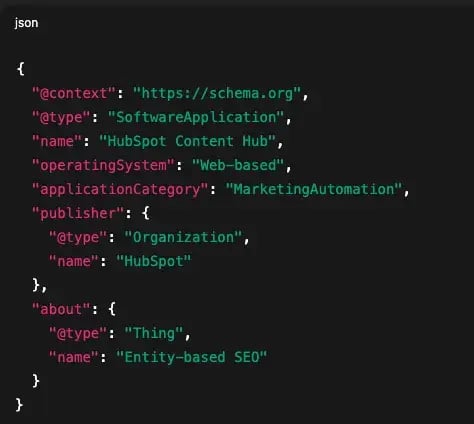
Free tools like Google’s Structured Data Markup Helper generate this code automatically, and the Rich Results Test confirms it’s working before publication. The payoff? Better chances of appearing in rich snippets, AI-generated answers, and knowledge panels — the high-visibility spots that drive real traffic.
How to Plan Topic Clusters With SEO Entities
Topic clusters turn entity discoveries into a structured editorial strategy by mapping how concepts relate and reinforcing those relationships through content. Entities form the foundation of these clusters, linking related ideas through shared context, internal linking, and consistent topical framing.
Effective clusters mirror how people research subjects: beginning with a broad concept and moving into increasingly specific subtopics. Entity relationships naturally guide this progression by showing which concepts belong together and how deep each area should go.
Here’s what effective entity-based clustering looks like in practice:
|
Core Pillar Topic (Entity) |
Supporting Entities / Subtopics |
Content Type |
Goal / Intent |
Internal Linking Example |
|
Customer Relationship Management (CRM) |
Contact Management, Lead Scoring, Sales Forecasting, Pipeline Automation |
Blog posts, tutorials, comparison guides |
Educate and attract top-funnel traffic |
Each subtopic links back to the CRM pillar page and cross-links to the others where relevant |
|
Marketing Automation |
Email Sequences, A/B Testing, Segmentation, Personalization |
Blog posts, ebooks, video walkthroughs |
Guide readers from awareness to consideration |
“Email Sequences” post links to “A/B Testing Best Practices” and the main “Marketing Automation Tools” pillar |
|
Data Integration |
API Management, ETL Processes, Data Hygiene, Data Governance |
Case studies, how-to articles, whitepapers |
Build trust and authority |
Each supporting piece links up to the “Data Integration Strategy” pillar and references relevant “CRM” or “Automation” posts |
Clusters become most useful when they directly inform content creation. Each entity turns into a content opportunity with clear intent and a defined set of internal links. For example, a page about email sequences naturally connects to A/B testing, lead nurturing, and the broader marketing automation pillar. These connections follow patterns that readers expect and search engines reward.
HubSpot’s Content Hub operationalizes this structure at scale by transforming entity insights into reusable brief templates and maintaining editorial consistency across expanding content libraries. Whether the output is a blog post, case study, or video, the platform helps ensure each piece strengthens the broader entity map.
Clusters also help identify gaps. When competitors rank for entity relationships missing from existing content, those gaps become a built-in roadmap for future editorial planning and quarterly content development.
Pro tip: Check out these SEO best practices for more tips and strategies.
How to Measure and Report on Entity-Based SEO Strategy
Measuring entity-based SEO focuses on whether search engines recognize and reward topical authority across related concepts, not on the performance of individual keywords. The strongest indicators show growth across clusters, improved semantic coverage, and greater visibility in the SERP features that rely on contextual understanding.
Track cluster-level performance in Google Search Console.
Google Search Console provides the most direct view of entity-led progress. Instead of isolating keyword-level queries, monitor impressions and clicks across entire clusters of pages tied to a shared concept. Rising visibility across these interconnected pages signals that Google understands the entity relationships and is treating the site as an authoritative source within that domain.
Evaluate internal link density and relationship mapping.
Entity-rich sites demonstrate tight internal linking between related topics. As clusters grow, the density and consistency of these links help search systems understand how concepts reinforce each other. HubSpot’s Content Hub automatically surfaces related pages and suggests internal links, ensuring supporting content connects back to pillar pages and to relevant subtopics. Over time, this creates a semantic network that signals depth and authority.
Monitor SERP features influenced by entity clarity.
Entity-optimized content is more likely to appear in featured snippets, knowledge panels, and AI-generated answer boxes — all of which rely on structured context rather than keyword matching. Increases in these placements show that search engines can clearly interpret the page’s meaning and its relationship to other concepts.
Connect entity performance to engagement and outcomes.
Entity authority often correlates with stronger behavioral metrics. As clusters mature, rising impressions typically appear alongside higher engagement, stronger time-on-page, and more consistent conversion paths. When search systems understand the relationships between topics, the content surfaces in more relevant contexts — driving better downstream performance.
Use AI Search Grader for emerging visibility signals.
HubSpot’s AI Search Grader adds a forward-looking dimension by showing how a brand appears across AI-driven search environments such as ChatGPT, Gemini, and Perplexity. These insights help determine whether entity signals are strong enough for LLM-based retrieval and where additional semantic reinforcement may be needed.
Frequently Asked Questions About Entity-Based SEO
Are entities the same as keywords?
No. Entities differ from keywords because entities have context and relationships. Keywords are text strings that reflect how people search, while entities are the underlying concepts that those strings refer to. For example, “CRM platform” is a keyword; HubSpot is an entity representing a specific product and organization. Entities help search systems understand meaning and context rather than matching text alone.
Do I need schema to benefit from entity SEO?
Schema markup is helpful but not required for entity SEO. Schema markup disambiguates entities for search engines. It provides explicit, machine-readable definitions of the entities on a page and how they relate to one another. Schema increases clarity for search engines and often improves visibility in featured snippets, knowledge panels, and AI-generated summaries.
How do I find related entities for my topic?
Tools such as Google’s Natural Language API, Ahrefs, and Semrush surface entities commonly associated with a primary concept. Wikipedia, People Also Ask panels, and related searches also reveal trusted entity connections. Internal linking further reinforces those relationships by mapping how concepts support one another within a cluster.
How do entities affect rankings?
When Google recognizes strong entity coverage, visibility improves across multiple related queries rather than just one term. Entity-driven pages often show consistent growth across entire clusters because search systems understand how each piece fits within a broader topic.
What’s the best way to measure entity SEO results?
Monitor impressions, clicks, and ranking trends for entity-aligned clusters in Google Search Console. Track internal link development and SERP feature visibility to assess whether semantic authority is increasing. HubSpot’s AEO Grader shows how clearly brand entities appear across AI search experiences.
How can I make my content more AI-friendly using entities?
Clear definitions, consistent naming conventions, and structured internal links make entity relationships explicit for AI models. Breaking up dense paragraphs, using schema markup where appropriate, and maintaining consistent terminology across assets improves machine interpretation. HubSpot’s Content Hub supports this by standardizing briefs and reinforcing entity-aligned patterns across content libraries.
Shift from keywords to entity-based SEO.
Entity-based SEO reflects how modern search engines interpret content through context and relationships. When those relationships are clear, visibility improves across both traditional search and AI-generated experiences.
Content Hub makes this structure scalable by identifying entities, templatizing briefs, and maintaining semantic consistency across large content ecosystems. AEO Grader shows how entity signals perform in AI environments such as ChatGPT and Gemini — visibility that’s increasingly important as search continues to evolve.
The shift from keywords to entities changed my approach to content strategy. When clusters formed around natural relationships rather than isolated terms, it became clear why Google rewards content that connects ideas. The strongest performers weren’t the pieces packed with keywords — they were the ones that demonstrated how concepts relate.
As AI plays a bigger part in information retrieval, building content around entities ensures long-term visibility and credibility. The goal extends beyond ranking for individual queries; it centers on producing content that earns authority through genuine expertise, meaningful relationships, and clear semantic structure.

